
Quick Answer
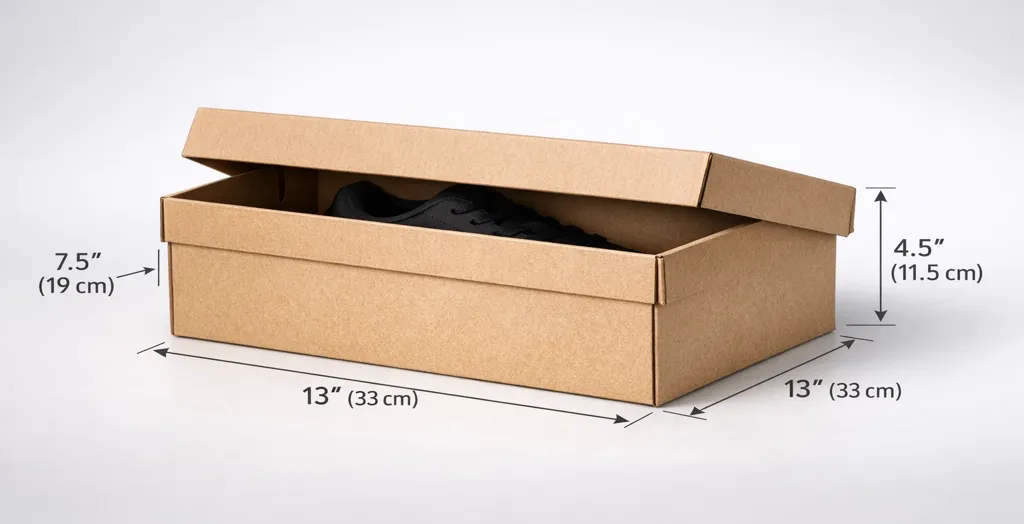
A standard shoe box in the UK typically measures around 33 x 19 x 11.5 cm (13 x 7.5 x 4.5 inches), though sizes vary depending on the type of footwear. Men’s shoe boxes are usually larger than women’s, while children’s shoe boxes are smaller and more compact. Boot boxes tend to be taller, while athletic shoe boxes are slightly bulkier due to padding.
Shoe box dimensions are not fixed. Brands adjust packaging based on shoe design, protection needs, and presentation. Many businesses now use custom sizes to improve fit, reduce shipping costs, and enhance branding.
The standard shoe box size in the UK is roughly 33 x 19 x 11.5 cm (13 x 7.5 x 4.5 inches). It works for most everyday shoes, but not all. Trainers, boots, and children’s footwear require different dimensions. The right size affects protection, storage, and shipping costs.
Most people assume a shoe box is just… a box. Same size, same purpose. That idea usually breaks the moment products start moving through real conditions. Boxes get stacked, pushed into shelves, packed into vans. A slightly oversized box wastes space. A tight one damages the product. This is where sizing starts to matter more than people expect.
What Is the Standard Shoe Box Size in the UK?
In the UK market, the most common shoe box size sits around:
- 33 x 19 x 11.5 cm
- 13 x 7.5 x 4.5 inches
This size works well for standard low-top shoes like casual footwear or basic trainers. But it is not a fixed rule.
Some brands adjust dimensions slightly depending on their shoe packaging style or branding needs. Even a small change in height or width can affect how the box performs in storage or shipping.
A quick thing most guides miss, this standard size starts to struggle with bulkier designs. Thick-soled trainers or padded sneakers often need extra internal space, otherwise pressure builds inside the box.
These dimensions work for most low-top footwear, but they often fail for bulkier designs like trainers with thick soles.
Shoe Box Dimensions by Type of Footwear
Not all footwear fits into one standard. Different categories demand different dimensions.
Men’s Shoe Box Dimensions
Men’s boxes are generally larger in both length and width.
- More toe space required
- Wider base for stability
- Handles slightly heavier weight
Typical range stays close to the standard size, but often runs slightly wider.
Women’s Shoe Box Dimensions
Women’s boxes are usually a bit smaller.
- Narrower shape
- Lower overall weight
- More variation due to design styles
Heels and fashion footwear can change dimensions quite a bit, especially when height comes into play.
Children’s Shoe Box Dimensions
Children’s shoe boxes are compact and efficient.
- Smaller footprint
- Easier to stack
- Better for bulk storage
From a logistics perspective, these are the most space-efficient boxes to handle.
Trainer / Sneaker Boxes
This is where things change.
Trainers often require:
- Extra internal space
- Room for cushioning
- Protection for shape retention
That added space increases shipping volume, which many businesses overlook until costs rise.
Sneaker packaging often includes extra space for cushioning, which increases shipping volume significantly.
Boot Shoe Box Dimensions
Boot packaging needs more height than anything else.
- Taller structure
- Reinforced sides
- Balance between height and strength
A weak tall box tends to collapse from the sides first, especially under stacking pressure.
Note: Some brands intentionally oversize boxes for visual impact, even if it increases logistics costs.
Shoe Box Size Chart (Inches & CM)
| Shoe Type | Inches (L x W x H) | CM (L x W x H) |
|---|---|---|
| Men | 13 x 7.5 x 4.5 | 33 x 19 x 11.5 |
| Women | 12 x 7 x 4 | 30 x 18 x 10 |
| Kids | 10 x 6 x 3.5 | 25 x 15 x 9 |
| Boots | 14 x 10 x 5 | 35 x 25 x 13 |
These are general benchmarks. Real packaging often shifts slightly depending on brand positioning and product design.
Why Shoe Box Sizes Vary
There is no single universal size because multiple factors affect packaging.
- Shoe construction varies
- Branding influences box proportions
- Protection requirements differ
- Retail and eCommerce needs are not the same
Some brands deliberately use larger boxes for presentation. It looks better on shelves, but increases shipping volume and cost.
Common Materials Used for Shoe Boxes
Material choice affects how the box performs, not just how it looks.
- Corrugated cardboard → Strong, absorbs impact during shipping
- Kraft boxes → Eco-friendly, slightly softer structure
- Rigid boxes → Premium feel, used more in retail than shipping
- Recycled materials → Cost-effective and sustainable
A small detail many miss, low-quality corrugated board usually fails at the corners first. That is where most damage starts during stacking.
Low-grade corrugated board tends to crush at the corners first, especially under warehouse stacking pressure.
Why Choosing the Right Shoe Box Size Matters
Sizing is not just about fitting the shoe inside.
- Prevents movement and damage
- Reduces shipping costs
- Improves storage efficiency
- Enhances customer experience
Even a slight size increase can push a package into a higher courier pricing bracket due to volumetric weight.
Note: Even a small size mismatch can increase courier costs due to volumetric weight pricing.
Custom Shoe Box Sizes for Businesses
Standard sizes work… until they don’t. As product lines grow, limitations start to show.
This is where custom packaging boxes become practical. Businesses move towards tailored sizes to reduce wasted space and improve consistency across products. Using the right cardboard packaging structure also improves durability during shipping, while switching to eco-friendly packaging options helps brands meet sustainability goals.
Benefits of custom sizing:
- Better product fit
- Stronger brand presentation
- Reduced material waste
- Lower long-term logistics cost
Most growing brands shift to custom sizing once they realise how much space and cost standard boxes waste over time.
If you’re ordering in bulk, even a small change in shoe box size can reduce wasted space and lower your shipping costs significantly.
How to Measure a Shoe Box Properly
Getting measurements right is simple, but often done incorrectly.
- Length → longest side
- Width → shorter side
- Height → depth of the box
Always measure from the outer edges, not inside space. This matters for shipping calculations.
Note: Always measure from the outer edges, not internal space, especially for shipping calculations.
Shoe Box Dimensions for Shipping and Storage
This is where packaging decisions show real impact.
- Courier size limits affect pricing
- Stackability determines storage efficiency
- Warehouse space depends on uniform sizing
- Poor sizing increases wasted space
Boxes that don’t align properly reduce pallet efficiency. That leads to higher storage and transport costs without most businesses realising why.
Poorly sized boxes reduce pallet efficiency, which directly increases storage and transport costs.
Eco-Friendly Trends in Shoe Packaging
Packaging is shifting.
- Use of recyclable materials
- Minimalist box designs
- Reduced ink and coatings
- Focus on reuse
Many UK brands now prefer simple structures that are easier to recycle. Complex packaging looks good, but often creates disposal issues.
Note: Many UK brands are shifting to mono-material packaging to simplify recycling processes.
Conclusion
There is no single “perfect” shoe box size. Standard dimensions work as a starting point, but real performance depends on how the box is used, stored, and shipped.
Businesses that pay attention to sizing tend to see fewer damaged products, better storage efficiency, and smoother logistics overall.
If you’re looking to improve packaging performance, moving towards properly sized, well-structured shoe boxes can make a noticeable difference in both cost and customer experience.
